
God and Creation
Making Every Class Catholic: A Practical Guide, Chapter 2.2

This is a draft of the second chapter of Part II of Making Every Class Catholic: A Practical Guide. The draft Table of Contents is available here with hyperlinks to previously published chapters.
“The heavens are telling the glory of God.”
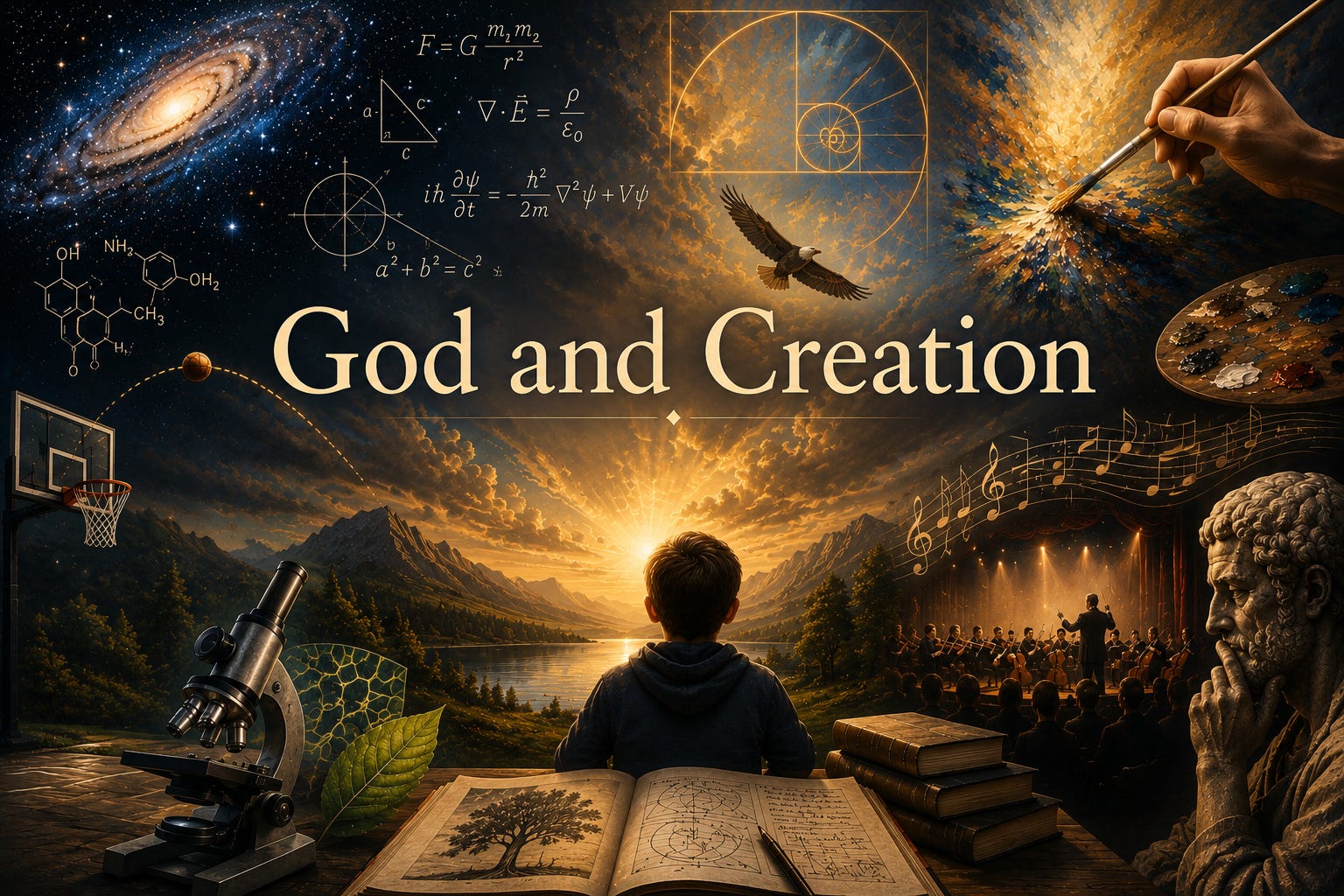
God reveals himself to us in many ways. When we speak about “revelation,” we usually mean God’s explicit saving acts in history as witnessed to us in Scripture and tradition. Theologians call this “special revelation.” And it is this that we study in theology class. But there is also what theologians call “general revelation.” This refers to the fact that creation itself is already a kind of revelation. And it is this—creation—that we study in every other class. There are some things we can only know about God because of special revelation, but there are many things that we can learn about God by simply paying attention to creation.
From the inner workings of the human psyche to the vastness of the cosmos, from the mechanics of a good free throw to the cadence of a sonnet, everything that we encounter in school is an encounter with creation. And just as we can always learn something about an artist by contemplating their works, an encounter with creation is always an encounter with the creator. And, as many of the founders of modern science explicitly taught, as we learn more about God through the study of creation, we can come to love him more.
Any spouse or parent knows about this dynamic. On an episode of The Making Every Class Catholic podcast, Dr. Andrew Salzmann told a fun story about shopping with his wife. When she found the tea she loved, she did a little victory dance in the aisle of the grocery store. And, when Dr. Salzmann learned that his wife danced for her favourite tea, his love for her was deepened.
Similarly, the natural end of any new insight or knowledge about creation is praise and love for the creator. Indeed, it is a remarkable thing that we find this impulse even in non-believers. Some encounter or other with beauty, often in the arts or in nature, gives rise to a sense of gratitude, a need to say thank you, even with no one to thank.
We hear a lot today about a focus on truth, goodness, and beauty in Catholic education. Theologians call these “the transcendentals.” The idea is that anything that is truly one of the three is, in fact, all three: nothing is good that is not beautiful and true; nothing is beautiful that is not true and good; nothing is true that is not good and beautiful. And nothing is true, good, and beautiful unless it reveals (because it participates in) the source of all truth, goodness, and beauty.
This is why people experience God when they grasp the solution to Apollonius’s circles (truth), or embrace a rival after the championship game (goodness), or are a part a triumphant opening night of the drama production (beauty). Of course, we often fail to recognize that we are experiencing God in those moments. But we do know that we are experiencing something transcendent, something that reaches beyond the particulars of the moment, something universal, something that points beyond itself and puts a question to us: something that introduces wonder.
This reaction is so natural and spontaneous that we almost have to be trained out of it. And much education today can feel geared towards just that. If it emphasizes disconnected skills and facts with an admonition that they will be needed for college admissions or the market, but de-emphasizes connection and meaning, wonder starts to fade. Meaning, kids can easily get the impression, is something you might indulge in on your own time, if you’re so inclined, but it has no place in school, where you are being prepared for the so-called “real world.”
A Catholic education, on the other hand, should double down on wonder. It should train every student to notice what is happening both in the world and in themselves when they encounter the world. It should be second nature to any product of Catholic education to, as the Jesuits refrain goes, find God in all things.
